GEOverse AU Primer
Formerly known as the GEO AU Project, the GEOverse is an alternate take on the pokémon universe in which pokémon are a recent phenomenon, having only existed for the past fifty years or so.
The timeline splits from that of the real world in the late 60s during the Space Race, which was interrupted by meteor impacts across the planet that brought with them a virus designed to terraform a planet into one habitable for pokémon life. After three world-wide plagues and a final, destructive world war, human society began to rebuild in the wreckage as pokémon—and the plants to support them—finished colonising the devastated environments of the Earth.
The setting of the GEOverse is post-post-apocalyptic, as most of the major rebuilding has already occurred, life is mostly back to normal, and the majority of the characters we know are the first generation to grow up after the conclusion of the Third Plague. It is a little more grounded in reality than canon, though leans into science fiction thanks to the fictional technology the pokémon world possesses.
The GEOverse is primarily a games-based AU, although things I find particularly interesting from the other canons might be incorporated from time to time. Most of the storylines from the mainline game canon* occur in some form from the late 90s onwards.
* PLA and PLZA are not canon to the GEOverse timeline, and substantial edits have been made to most game plotlines to support the lack of thousands of years of pokémon history. No mythology from canon has any basis in reality in the GEOverse.
A Brief History of the GEOverse

The GEOverse diverges from real-world history when an approaching asteroid interrupts the Space Race between the USA and USSR. The rival powers sent a united force to attempt to detonate a bomb on the incoming rock—but instead of knocking it off course, it instead fragmented the asteroid, and contact was lost with the shuttle in the chaos of those fragments making landfall.
The largest piece landed in the Three Gorges area of the Yangtze River, and other larger fragments crashed into the Andes, Alaska, Siberia, and central Spain. Over the coming weeks, scientists from multiple countries travelled to the impact sites to survey the damage and gather samples.
The composition of the meteorites was unusual—they were stony-iron pallasite-like formations, with shimmering blue-white crystal suspended in an iron matrix. They also appeared to have voids containing water within, something that should not have been possible.
Several weeks later, animals in the areas around the impact sites began acting strangely, falling ill and dying. It was considered a mild oddity until the first human cases occurred, spread from infected animals to nearby populations.
This was the beginning of the First Plague. The cause was a strange, alien virus, given the moniker DXZ as it was studied in labs around the world. As the virus spread, leaping from animal populations to human ones with ease, governments around the world attempt to instate quarantine measures.
These measures broke down nearly immediately, largely as a result of large business owners lobbying against economic slowdown. The slowdown happened anyway, however, as workers died or were disabled en masse as a result of DXZ infection, and spending on anything but essentials slowed to a trickle.
The First Plague gradually tapered off as early vaccines were distributed, but a great deal of damage had been done to both humanity and the ecosystem as a whole. Efforts to create more reliable vaccines began as humanity attempted to pick up the pieces.
The next couple of years was seemingly stable, but the zoonotic, airborne virus was simply simmering in the background as it spread. The Second Plague began with the first observed manifestation of the active phase of the virus in wildlife, and spread quickly through domestic animal populations as plant life around the world began to wither.
A new form of vaccine was developed during the Second Plague—rather than trying to build immunity through introducing deactivated viral particles, one lab developed a specific strain of the virus that kept rats more or less rat-shaped after inoculation. A desperate race began to preserve as many domestic animal species as possible as livestock populations plummeted across the world.
The collapsing food chains, however, drove tensions high—and an all-out war was sparked when the USA forcibly annexed Canada and Mexico before reaching across the ocean for any resources it could take. Other countries went on the defensive, attempting to protect themselves or snatch their neighbours’ resources for themselves.
The war later known as the Last War dragged on for three years, causing widespread destruction and exacerbating the effects of the second plague. It was eventually brought to an end through a combination of dwindling resources and targeted strikes on the remaining ringleaders. The end of the War allowed survivors to finally bring the Second Plague to an end.
In the wake of the War, many cities and towns were left heavily damaged or destroyed. Some were abandoned, while others were rebuilt, and many countries fragmented into smaller, self-governed regions due to the general loss of infrastructure. Fruit-bearing plants that had arisen in the wake of the plague and domestic species that had been preserved by altered virus strains were used to re-establish the food supply chain.
Pokémon training had arisen during the War as a defensive measure, but as the environment was repopulated with wild pokémon, handlers began to train their charges to defend the human population. The first pokémon league opened in Kanto, Japan, and many other regions followed their example.
Pokémon training gained popularity fast, especially after the invention of the first pokéballs in 1979—at which time, the word “pokémon” was coined. Efforts to document the strange new wildlife began in earnest.
Humans were still largely unaltered at this point, however. Research on how to make the hybrid alien food more palatable kicked into high gear, resulting in many wild food trends.
The Third Plague arose from a combination of poor nutrition and beleaguered human immune systems. Quarantine measures were more closely followed this time, but pokémon were now as integral to the environment as animals once were, so the zoonotic virus was nearly impossible to keep out.
Scientists rushed to create a new preservation strain in a desperate attempt to save humanity like they had so many animal species. They were finally able to synthesise a functional strain using samples donated by post-human survivors from all over the world, using their mutated DNA as a blueprint for which parts of the virus to tweak.
The third and final of the plagues was tamed by a concerted global vaccination effort. Humanity saved itself by changing itself just enough to avoid further infection—and finally succeeded in making the mutant food palatable in the process.
The events of RG/B occur roughly ten years after the conclusion of the Third Plague. Fifteen-year-old Blue Oak and fourteen-year-old Satoshi “Red” Takeda set out from Pallet Town—a restored Shimoda, Shizuoka, Japan—with cameras and field journals stuffed in their packs and their sights set on the Indigo Pokémon League, inspired by the recent victory of another kid their age at the plateau.
Humanity in the GEOverse
GEOverse humans are biologically dissimilar to real-world humans, having altered their own genome in order to survive an environment warped to suit alien life. The Human Preservation Strain is not truly a vaccine, but a custom-edited virus designed to perform only the most necessary genetic edits to preserve human life. It succeeded in providing resistance to—but not total immunity from—the wild strains of DXZ carried by every other living thing on the planet.
Heritability of the genetic modifications is somewhat unreliable, however, so all living humans are given a course of eight booster shots, one every eighteen months from birth to the age of fifteen.
The modifications confer a few benefits aside from the resistance to DXZ and the improved ability to digest alien-derived foods. They live a little longer than real-world humans do, have a reduced chance of manifesting auto-immune diseases, and are generally hardier. GEOverse humans have a higher chance of surviving potentially lethal injuries, an important adaptation in a world where common pets can breathe fire or summon lightning.
Human Society in the GEOverse
In the wake of the Three Plagues and the Last War, the total global population was reduced by 60% to 1.4 billion people. Between the population loss and the damage caused during the war, the surviving populations migrated more towards the major population centres that rebuild. Many smaller settlements were abandoned and left for nature to reclaim, although others remain stubbornly inhabited.
Real-world borders are no longer in effect, as most countries fragmented during or after the Last War. Few pre-War governmental bodies survived, with most larger countries splitting into smaller regions in the wake of the destruction. Inter-regional land travel is difficult not because of expense or bureaucracy, but because large swathes of wilderness inhabited only by powerful wild pokémon have overtaken much of the world’s landmass.
Most regions are analogous to the real-world places that inspired them, most inhabited settlements having been rebuilt and repopulated after being damaged or destroyed during the war. For example, Celadon City in Kanto is a restored Tokyo City, Japan; Wyndon is a new city built over the ruins of London in the UK, which has been entombed under a concrete sarcophagus; and Castelia City is a partially rebuilt New York City, North America, which was completely levelled during the War.
Car travel is far less prevalent in the modern day, with people largely relying on walking, biking, riding or flying on a pokémon, or utilising public transport like trains, buses, or ferries. International travel and long-distance shipping relies on a combination of planes, ships and trucks.
The total global collapse caused by the plagues and the War keeps most regions funding their healthcare infrastructure. The active phase of DXZ remains a present threat, in much the way an endemic disease like rabies does, and cases of infection arise periodically.
Post-Humans

In the GEOverse, the term post-human refers to the living survivors of spontaneous metamorphosis, a process that occurs in roughly 30% of active phase DXZ infections. The majority of living post-humans in the current day are survivors of one of the first three plagues, with infections being much rarer after the conclusion of the Third Plague.
Spontaneous metamorphosis involves the active phase of DXZ forcibly introducing alien genes into the DNA of non-pokémon organisms. At best, survivors only receive minor mutations such as hair loss, skin changes, reduced motor control, vision and/or hearing loss, reduced immune function and mental problems such as brain fog or aphasia. At worst, survivors can become nearly unrecognisable as human, their bodies warping in an attempt to follow the alien blueprint.
Post-humans only display traits from a single pokémon species rather than a mix. Clusters of survivors often display the same mutations—such as the kadabra traits displayed by the Saffron survivors, or the druddigon traits displayed by the Blackthorn survivors.
Post-humans don’t receive any benefits from their mutations, and most suffer from lifelong disabilities and chronic pain. The mutations also do not confer immunity to DXZ, so further infections can still be lethal. Those with visible mutations are often social outcasts, despite the fact that the infection has run its course and can no longer be passed on.
Hybrids

In the GEOverse, a “hybrid” is any human with at least one biological post-human parent. Unlike their post-human parents, hybrids tend to be more physically normal, their alien traits more smoothly integrated into their human forms. Obvious tells include unnatural eye and hair colours, nonhuman pupil shapes, nonhuman dentition such as obvious fangs or full sets of sharp teeth, and nail beds that twist into claws as they grow.
Most hybrids are able to understand and speak one or more of the thirteen pokémon language groups. Some inherit moves or innate abilities from their alien DNA, and all living psychics are hybrids of psychic-type pokémon such as kadabra, medicham or gardevoir. And unlike any regular humans or post-humans, hybrids are entirely immune to DXZ, unable to catch or even carry it in their bodies.
However, hybrids don’t get the advantages without drawbacks. They look unusual and attract unwanted attention—they are often social outcasts, seen as monsters, freaks, or potential carriers of disease despite their immunity. Their senses—especially their sense of smell—are often overclocked, leaving them more sensitive to external stimuli than regular humans. Psychic hybrids are unable to completely shut off their ability to sense emotions and surface noise from other living beings, and are forced to manage it with anti-psychotic medication. The majority also struggle with the patchwork of human and pokémon instinct they’ve inherited.
Being a hybrid is often an isolating experience, and many hybrids attempt to hide their less human traits to better blend in, or flock together to avoid regular humans entirely.
Food in the GEOverse
A proper food document is currently in WIP status.
The Second Plague caused a mass extinction of plant and animal life, resulting in most real-world food sources becoming extinct. Gradually, the food chain recovered as plants and animals mutated by DXZ began repopulating the planet after the plague had run its course. Until the conclusion of the Third Plague and the mass genetic modification of humanity, however, humans derived very little nutrition from these mutated food sources.
Wheat, rice and soy were saved from extinction thanks to the same genetic tampering that saved humanity and many of their domesticated species. Some edible seaweeds were also preserved, but most fruits and vegetables were replaced by the berry plants that descended from them.
The bulk of the modern human diet, however, is pokémon-derived. Torchic eggs, miltank and skiddo milk and dairy products derived from them, as well meat from tauros, torchic, oinkologne, wooloo, and various fish and shellfish pokémon are the major components of the modern diet. Other pokémon-derived products, such as the mushrooms that are found to grow on paras’ back, can be grown and harvested independently of the pokémon.
Some pokémon-derived foods are considered rare delicacies. Slowpoke tail is an infamous example, as commercial harvesting of tails is actively harmful to the pokémon but the consumption of such is seen as a high class luxury.
Vegetarianism and veganism are on the rise in the younger generations, supported by attempts to revive old world crops as well as the opening of at least one major vegetarian fast food chain.
DXZ
DXZ is endemic to the world of the GEOverse, existing within almost every living thing on the planet. It is usually only referred to as DXZ in medical contexts, with regular people generally referring to it as pokérus.
The virus’ effects are oddly beneficial for pokémon, helping them grow in power faster, but it remains a deadly threat to human life. Vaccines exist as a preventative measure, but they are mostly effective against the inactive phase of the virus. Despite that limitation, these vaccines are free world-wide—in the rare cases regional governments don’t supply them, charities distribute vaccines through pokémon centres.
The virus consists of two phases; an inactive phase (DXZ-IP), in which it lies dormant within living cells, and an active phase (DXZ-AP), in which it is actively infectious and spreads easily. The active phase of the virus breaks through species barriers with ease, and can be passed easily to humans by infected pokémon.
DXZ-AP has an incubation period of 1-2 weeks in non-pokémon life forms. Symptoms of infection include fever, chills, joint pain, fatigue, dizziness, brain fog, hypertension, tachycardia, aggression, sensitivity to light, itching, skin discolouration, rashes or hives, organ injury or failure, and physical mutation. Once symptoms appear, the disease progresses rapidly. Treatment must be sought as quickly as possible in order to prevent a case of spontaneous metamorphosis.
Spontaneous metamorphosis refers to the catastrophic physical mutation seen in the worst DXZ-AP infections. The virus appears to attempt to rewrite the DNA into something that resembles pokémon DNA—a process that causes the body to reject itself as its own tissues begin to twist into something unrecognisable.
Historically, those who experienced spontaneous metamorphosis survived with disfiguring and/or disabling mutations. In the modern day, however, severe physical mutation is rare thanks to an intensive care routine developed during the end of the Third Plague. A combination of antiviral medications, vaccine boosters, and infusions of hybrid blood and post-human cell cultures has proven effective at slowing the onset, or even stopping spontaneous metamorphosis from occurring entirely.
Medicine in the GEOverse
While most human medicine remains the same as it does in the real world, the most important difference aside from DXZ vaccination is the existence of the fictional chemical, doxenaquine.
Doxenaquine was developed by the former US during the Last War, and was used to prop up an ailing fighting force as the tides turned against the war’s instigators. It is a hybrid steroid medication that causes rapid cell growth upon contact. Doxenaquine is the core ingredient of all healing potions, and the backbone of pokémon medicine. Even weak potions can seal wounds in moments, and the strongest potions can be literally life-saving.
Doxenaquine is, however, carcinogenic to humans, and can be lethal at higher concentrations. It can cause catastrophic cell mutation, nerve damage and organ failure, and is heavily regulated for this reason. In human medicine, it tends to be a last-ditch measure, after every other option has been exhausted and the risk of future cancers has been weighed against continued survival.
Pokémon in the GEOverse

GEOverse pokémon are similar to their anime or Mystery Dungeon counterparts, in that they are highly intelligent, perfectly capable of understanding human speech and making complex decisions, but only rarely able to speak human languages.
GEOverse pokémon are their own kingdom of closely related species, which are split into “egg groups” that are genetically related enough to be able to interbreed. Hybridisation never occurs in the GEOverse, with offspring of any cross species pairing taking their species from the mother and some traits from the father.
An unusual quirk of pokémon biology is the formation of pokémon eggs—a sort of soft, leathery cocoon, which most mother pokémon create with saliva or other bodily fluids to hide their newborn young from predators. These are very common in breeder facilities, as being surrounded by strange humans and pokémon can cause mother pokémon to become anxious about their offspring’s well being. In the wild, many pokémon give live birth, with true eggs being mostly restricted to the flying, water 2 and dragon egg groups.
All pokémon in the GEOverse are descended directly from the mutated animals that survived the plague—some from the unstable blobs of cells that later came to be called ditto, others from animals that were changed either by DXZ-AP infections or the first generation preservation strain vaccines. They are more alien in nature than the altered humans are, so the active phase of DXZ doesn’t cause them anything more than a mild state of heightened aggression for a week or so.
Language and Culture
There are thirteen egg group-related languages, all of which are interpretable as languages if studied. Many rely on subtle body language cues as well as sounds, so regular humans struggle to really understand them without a great deal of familiarity. Communication between the language groups is surprisingly smooth—pokémon can almost universally understand other pokémon.
Pokémon culture is less defined in the current era. As all extant pokémon are descended from non-sapient* animals, their lifestyles echo their ancestors in many cases. Most species have their own quirks related to grouping up and working together or raising young, but only a few stable inter-species communities have formed. Inter-species communities tend to have stricter rules on issues like predation, and may steal resources from human settlements to try and meet nutrition needs as a result.
For pokémon, the struggle is figuring out which instincts to leave behind and which to retain as they attempt to settle their differences.**
Obviously, pokémon intelligence being on par with human intelligence raises a lot of ethical questions that are eventually addressed in-universe. Diets eventually move away from pokémon-derived products and towards plant-based foods such as berries and genetically engineered crops derived from their extinct real-world counterparts. This transition is the source of most of the conflict between the younger generations and those who survived the plagues.
*”Sapient” means possessing human level intelligence, animals were pretty unquestionably sentient but did not possess that higher reasoning ability.
**One of my biggest inspirations for pokémon society in the GEOverse is the webcomic Nature of Nature’s Art and its depiction of the gradual process of establishing animal society parallel to human development.
Variation
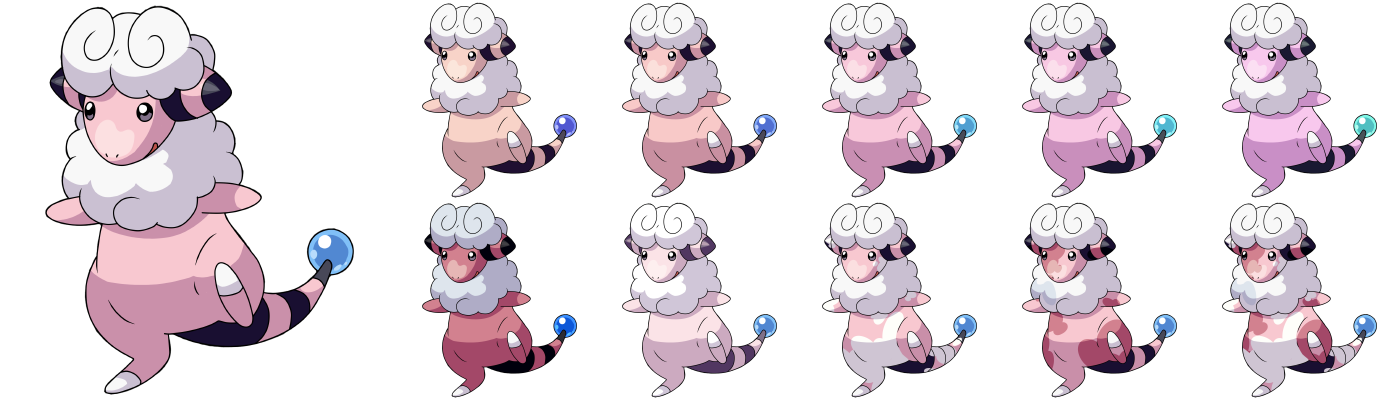
GEOverse pokémon all have individual variation, from size, weight, build, facial structure, and differences in overall hue/colour similar to the huesliding in Pokémon Stadium. Some colour variations are rarer than others, and white-spotting in particular only shows up in pokémon bred and raised by humans for a few generations.
Shiny pokémon exist independently of the basic colour variations, and tend to be analogous to rare conditions such as albinism. Much like albino animals in real life, shiny pokémon often stand out against their environment and attract predators (or worse, humans). Socially, they may be ostracised by other pokémon of their species because of this.

Alphas exist as particularly large and powerful members of a species, but are quite rare encounters.
Regional pokémon in the GEOverse are generally not tied to specific regions; rather, they are adaptations to specific environmental conditions that aren’t speciated enough to be considered a unique species on their own. Most are named after the first region they were recorded in, although there has been a recent push for the subspecies to receive their own names to reduce confusion. Regionals are subject to the same size, weight, build, and colour variations between individuals.
All Hisuian forms are known as Sinnohan forms and are contemporary inhabitants of Sinnoh in the GEOverse, as Hisui never existed in this AU.
Legendary Pokémon
Legendary pokémon in the GEOverse are extremely rare, extremely powerful pokémon from specific lineages. They aren’t unique, even in the case of mythical pokémon, with the exception of Arceus. GEOverse legendaries are not gods, and do not have any specific mythology attached to them, although they may attract some minor modern folklore.
Aside from their rarity, the biggest difference between legendaries and regular pokémon is the immense psionic power they all possess independently of psychic-typing. They can communicate effortlessly through telepathy and exert their will upon the environment around them and anything in it.
Capturing a legendary in GEO is a gargantuan undertaking, as it involves an immense battle of wills between the pokémon and its prospective trainer. No pokéball can contain a legendary pokémon with a 100% success rate, and a capture relies on the prospective trainer and the pokémon reaching some kind of accord and forming a telepathic bond. These telepathic bonds are exclusive, however—humans who attempt to control more than one find their psyches rent asunder by the territorial psionic battle between rival legendaries.
Arceus
Arceus is the originator of all pokémon life in the GEOverse, having sent the DXZ virus to Earth as a form of terraforming/colonisation. It is an extra-dimensional entity from another universe entirely, and its goals are simply to ensure the propagation and continued survival of pokémon as a species. It is an ancient being, which lives on a timescale so immense that it cannot comprehend the thoughts and feelings of individual mortal people.
Arceus’ powers are that of travelling in and out of realities at will, and by bringing objects and people from foreign realities into a target reality, it can affect substantial reality-breaking change. Remnants of this extra-dimensional power cling to the meteorites that brought DXZ to the planet, the crystals that grew at the impact sites, and formed into various plates and shards as the dust settled.
Plates, shards, and crystals harvested from the impact sites all carry residual extra-dimensional energy. Both the plates and crystals can be used to boost type-related pokémon abilities, and both can also make it possible for someone to slip between realities. Plates seem to have a particular internal logic, with each type of plate allowing access to a different group of realities. The GEOverse is always accessible through dark-type plates.

Battle Gimmicks
Mega evolution and primal reversion do not occur in the GEOverse, although mega stones and keystones brought in from other realities would still function within it.
Z-moves exist and are powered by small crystals harvested from the impact site on Mount Lanakila. Z-crystals are fairly easy to obtain and their use is not tied to geographical location. Z-moves are the most accessible of the battle gimmicks, as they don’t require a specific geographical location to activate.
Dynamax is a phenomenon that occurs only in Galar, and requires the use of dynamax bands manufactured by Macro Cosmos—the bands are nonfunctional outside of designated “power spots” in Galar’s stadiums. Dynamax can be harmful to pokémon if pushed beyond a three turn/five minute limit, so its use is heavily regulated.
Terastalisation, while not discovered until the late 2010s, is similar to z-moves in that it relies heavily on impact site crystals, but uses larger, stronger crystals to induce the effect. It does not physically change types, but rather generates a reality-altering effect around the pokémon. Terastal orbs can only be recharged by raw terastal crystal, and many regions don’t have the infrastructure to support them.